AI-Driven Skill Gap Analysis: Closing Workforce Gaps with Data
Organizations today operate in an environment where skills become outdated faster than ever. New technologies, evolving business models, and automation are constantly changing the capabilities companies need from their workforce. As a result, many organizations struggle to identify whether their employees possess the right skills for future demands. This is where AI skill gap analysis is transforming workforce planning.
Traditional skill assessments often rely on manual reviews, static job descriptions, or outdated competency frameworks. These approaches make it difficult for leaders to understand real workforce capabilities. By contrast, AI workforce analytics enables organizations to analyze large volumes of employee data and identify capability gaps with far greater accuracy.
AI-driven insights allow businesses to map current skills, detect missing competencies, and design targeted learning programs. Instead of guessing what employees need to learn, companies can use data to guide talent development and workforce strategy.
Understanding Skill Gap Analysis
Skill gap analysis refers to the process of comparing the skills employees currently possess with the skills required to achieve business goals. When gaps are identified, organizations can implement training, hiring, or reskilling strategies to close them.
In the past, skill gap analysis was often conducted through surveys, performance reviews, or manager feedback. While these methods provide some insight, they are limited in scale and often influenced by subjective opinions.
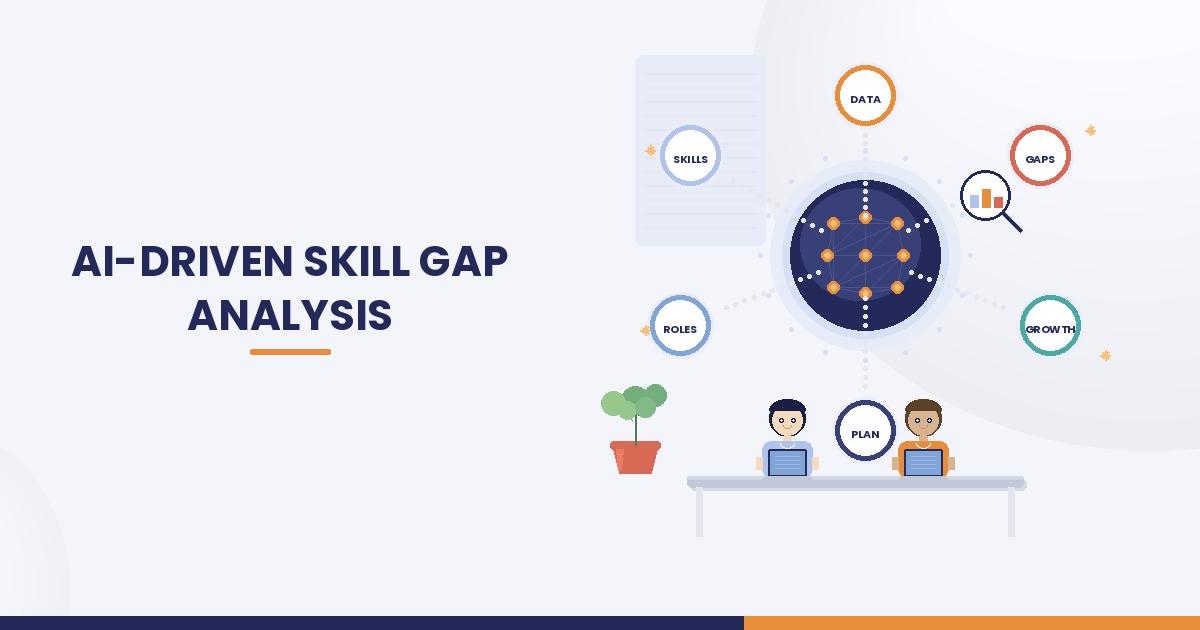
Modern skills analytics platforms use artificial intelligence to process information from multiple sources such as employee profiles, learning systems, project data, and job market trends. By analyzing these data points, AI provides a comprehensive view of workforce capabilities across the organization.
How AI Identifies Skill Gaps
One of the most powerful aspects of AI-driven workforce analytics is its ability to detect patterns that would be difficult for humans to identify manually. Understanding how AI identifies skill gaps begins with data collection and analysis.
AI systems gather data from several sources, including learning platforms, employee resumes, performance reviews, project assignments, and internal mobility records. Natural language processing algorithms then analyze this information to identify the skills employees possess.
Once these skills are mapped, the system compares them against future workforce requirements. These requirements may come from strategic business plans, emerging technology trends, or evolving job roles.
Through this comparison, AI identifies which skills are missing, which are declining in relevance, and which will become increasingly important. The result is a dynamic and continuously updated view of workforce capability gaps.
AI for Workforce Skills Mapping
A critical component of AI for workforce skills mapping is creating a detailed skills inventory for the entire organization. Instead of relying on job titles alone, AI identifies the actual capabilities employees demonstrate through their work.
For example, two employees with the same role might possess completely different skill sets. AI-powered systems analyze project contributions, training records, and performance data to capture these distinctions.
This granular mapping allows organizations to see where skills are concentrated, where shortages exist, and where hidden expertise may be located. In many cases, companies discover valuable capabilities within their workforce that were previously overlooked.
Skills mapping also helps leaders understand how teams collaborate and where cross-functional capabilities can be strengthened.
Benefits of AI Workforce Analytics
Using AI workforce analytics for skill gap analysis provides several advantages for organizations seeking to future-proof their talent strategies.
More Accurate Skill Insights
AI analyzes vast datasets to produce more objective insights than traditional assessment methods. This reduces reliance on guesswork or incomplete information.
Faster Workforce Planning
With real-time analytics, leaders can quickly identify emerging skill shortages and respond before they become major operational challenges.
Personalized Learning Paths
Once skill gaps are identified, organizations can recommend personalized training programs for employees. This targeted learning approach improves engagement and accelerates skill development.
Improved Talent Mobility
AI-driven insights help companies identify employees who are ready to move into new roles. By matching skills to opportunities, organizations can strengthen internal mobility and retain valuable talent.
Supporting Strategic Workforce Planning
Beyond identifying gaps, AI also plays an important role in strategic workforce planning. Organizations can simulate different business scenarios and evaluate the skills required for each scenario.
For instance, a company planning to expand into new digital services may need additional expertise in data analytics, cybersecurity, or AI development. Workforce analytics tools can highlight whether the current workforce has the potential to develop these capabilities or whether new hiring strategies are required.
This predictive capability helps businesses make more informed decisions about training investments, recruitment priorities, and organizational design.
Challenges to Consider
Despite its advantages, implementing AI-driven skill gap analysis requires careful planning. Data quality is one of the most significant challenges. If employee data is incomplete or inconsistent, analytics results may be less reliable.
Organizations must also ensure transparency in how workforce analytics systems operate. Employees should understand how their skills are being evaluated and how the insights will be used to support career development.
When implemented responsibly, AI-driven analytics can empower employees rather than simply monitor them.
Building a Future-Ready Workforce
The rapid pace of technological change means that workforce capabilities must continuously evolve. Companies that fail to track and develop employee skills risk falling behind competitors.
By leveraging AI skill gap analysis, organizations gain a clearer understanding of their talent landscape. Skills analytics platforms provide the insights needed to identify capability gaps, guide learning strategies, and align workforce development with long-term business goals.
As organizations increasingly adopt AI for workforce skills mapping, workforce planning will become more proactive and data-driven. Instead of reacting to skill shortages, companies will be able to anticipate future needs and build a workforce prepared for the challenges ahead.
